
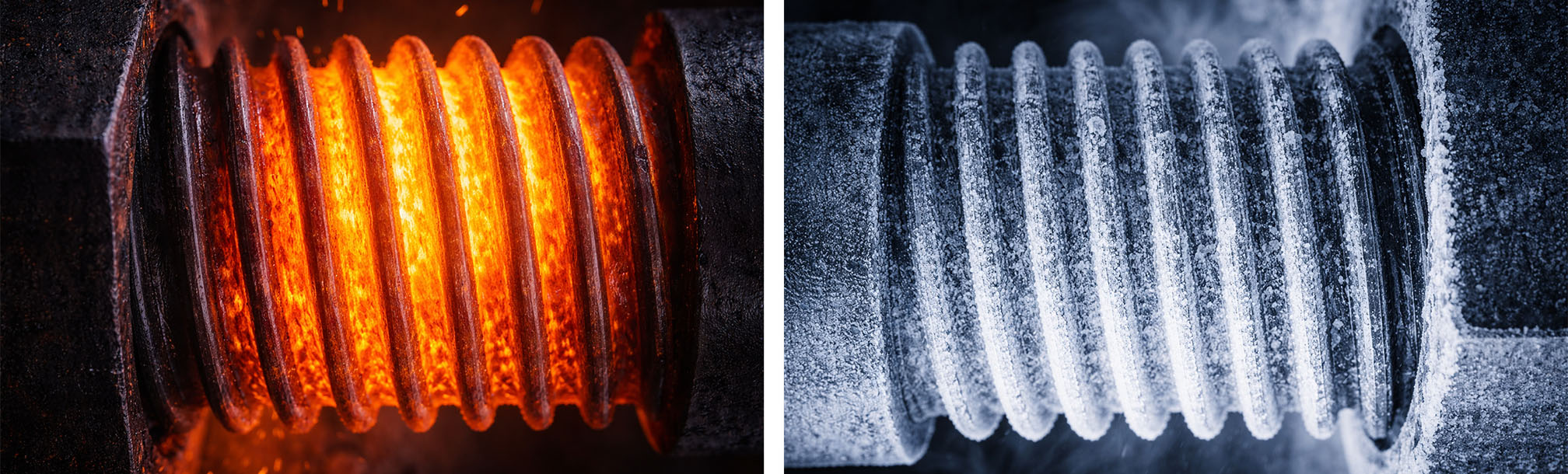
If you’ve spent any time around fastener manufacturing, you’ve probably run into three process names that get thrown around: cold heading, warm forging, and hot forging. They sound like a spectrum, and in a sense they are. But the middle option, warm forging, is often the least understood. This post walks you through what warm forging actually is, how it differs from cold and hot forging, and the situations where it earns its place on the fastener process sheet.
The three forging regimes, briefly
Forging processes for fasteners are generally classified by the temperature of the workpiece relative to the material’s recrystallization temperature:
- Cold heading: performed at or near room temperature, typically between 15° and 200°C (59° to 392°F). These temperatures are generally low enough that dynamic recrystallization does not occur during the forming operation.
- Warm forging: Now, warm forging doesn’t have an absolute temperature range, as the range is completely dependent upon the material being formed. Essentially it performed above room temperature but below the recrystallization threshold. This commonly falls between 600-900°C (1,100-1,650°F) range for carbon and alloy steels.
- Hot forging: performed above the recrystallization temperature, typically 900-1,250°C (1,650-2,300°F) for steel, where the material fully recrystallizes during and after deformation.
Each regime changes the material’s flow stress, ductility, and the tooling loads required to shape it, and those changes cascade into everything from part tolerance to tool life to microstructure.
What actually happens to the metal during warm forging
The core reason warm forging exists as a distinct process is metallurgical. As you heat steel, its flow stress (the resistance to plastic deformation) drops substantially. At the same time, ductility increases, meaning the material can undergo larger strains before cracking. As temperature increases, the flow stress of steel decreases substantially, making plastic deformation easier and reducing the force required to form the material.
This gives warm forging a useful middle ground. This is done for several reasons:
- Lower forming loads than cold forging: this reduces tooling stress and press tonnage requirements.
- Better formability for complex geometries (flanges, hex heads, multi-diameter shanks) that would work-harden excessively or crack if cold formed.
- Reduced oxidation and scale formation compared with conventional hot forging, which can help improve surface quality and reduce material loss.
- Reduced or eliminated need for intermediate annealing steps that cold forging often requires between forming stages.
How it compares to cold and hot forging for fasteners
Versus cold forging: Cold forging is the default for high-volume, standard fasteners because it produces excellent surface finish, tight tolerances, and, critically, favorable grain flow that follows the part’s contour, which improves fatigue strength. But cold forging has real limits: it requires higher tonnage, causes significant work hardening, and struggles with high-carbon or high-alloy steels, large upset ratios, or geometrically complex heads. Multi-stage cold forming often needs intermediate anneals to restore ductility between blows, adding process steps and cost.
Warm forging relaxes these constraints compared to cold forging. You get lower press loads, fewer or no intermediate anneals, and the ability to forge harder alloys or larger deformations in fewer strokes. The trade-off is somewhat looser tolerances and rougher surface finish than what cold forging can deliver.
Versus hot forging: Many engineers choose hot forging when you need large material displacement, are working with alloys that are simply too strong to cold or warm form, or are producing large fasteners (big diameter bolts, custom industrial hardware) where tonnage limits make cold or warm forming impractical. But hot forging brings scale formation, larger thermal contraction (worse dimensional control), and typically requires machining allowances and secondary operations to hit final tolerances.
Warm forging narrows the tolerance band relative to hot forging and reduces scale-related material loss and surface defects, while still getting most of the load and formability benefits of elevated temperature.
When warm forging is the right call
Now, we’re not saying that warm forging is the right way for every application. Instead, there are many instances when cold heading and hot forging are the way to go.
Cold forging is likely still better when you’re running high volumes of standard low-to-medium carbon fasteners where tolerance, surface finish, and fatigue-favorable grain flow are the priority, and tonnage isn’t a limiting factor.
Hot forging is likely still better when the part requires large-scale material displacement, very large fastener sizes, or alloys whose flow stress remains too high even at warm-forging temperatures, and post-forge machining is already part of the process plan.
When considering types of forging for fasteners, choose warm forging when:
- You’re forming medium-to-high carbon steels or alloy steels (e.g., 10B38, 4140, 8640) that would work-harden excessively or risk cracking if cold forged, but don’t need the extreme ductility (or can’t tolerate the tolerance loss) of hot forging.
- The part geometry involves significant upsetting or a complex head/flange shape that would require multiple cold-forming stages with intermediate anneals. Warm forging can often consolidate this into fewer operations.
- Press tonnage is a constraint. If your existing cold-forging line doesn’t have the tonnage to form a given alloy or size, warm forging can bring the required force within reach without upgrading to hot-forging equipment.
- You need better dimensional control and surface finish than hot forging delivers, but full cold-forging tonnage isn’t available or economical for the part in question.
- When tool life is a concern for a difficult alloy. Because flow stress is lower, warm forging reduces tool wear and cracking risk compared to cold forging the same material, extending die life.
- You want to avoid the decarburization and scale-related surface defects associated with hot forging, while still needing more formability than cold forging allows.
Practical considerations for implementation
Here are a few things worth flagging if you’re evaluating whether or not to use warm forging:
- Temperature control is critical. The process window between “warm” and “hot” isn’t a hard line; it’s defined by the alloy’s recrystallization behavior. Inconsistent induction or furnace heating can push parts of the batch into unwanted grain recrystallization or leave others too stiff to form properly.
- Die materials and coatings need to handle cyclic thermal loading, which is a different wear mechanism than the pure mechanical wear seen in cold forging dies.
- Descaling/oxidation is much less severe than hot forging but isn’t zero. Expect some surface oxide that may need to be accounted for in downstream finishing.
- Mechanical properties from warm forging typically fall between cold and hot forged parts: better fatigue performance than hot forging (due to more favorable grain flow and less grain coarsening) but not quite matching the strain-hardened strength of cold forged parts, unless followed by appropriate heat treatment.
The bottom line on warm forging
Warm forging isn’t a compromise process; it’s a deliberate choice when a fastener’s material, geometry, or tonnage requirements push it past what cold forging can comfortably handle, but where hot forging’s tolerance and surface trade-offs aren’t worth accepting. For medium-carbon and alloy steel fasteners with complex geometry or significant upset requirements, it’s frequently the process that gets you acceptable tooling loads, fewer process steps, and dimensional control that’s good enough to minimize secondary machining, which is exactly the kind of trade-off engineers are paid to make correctly.
Where does CFI fit in?
For over 30 years, Components for Industry (CFI) has been a worldwide provider in cold headed, warm forged and hot forged industrial components. Ready to discuss whether cold heading or hot forging is right for your project? Contact CFI at 847-918-0333 or sales@componentsforindustry.com today for a feasibility assessment and quote.
Warm forging is a metal forming process that falls between cold and hot forging. It doesn’t have an absolute temperature range, as the range is completely dependent upon the material being formed. It is performed above room temperature but below the recrystallization threshold. This commonly falls between 600-900°C (1,100-1,650°F) range for carbon and alloy steels.
