
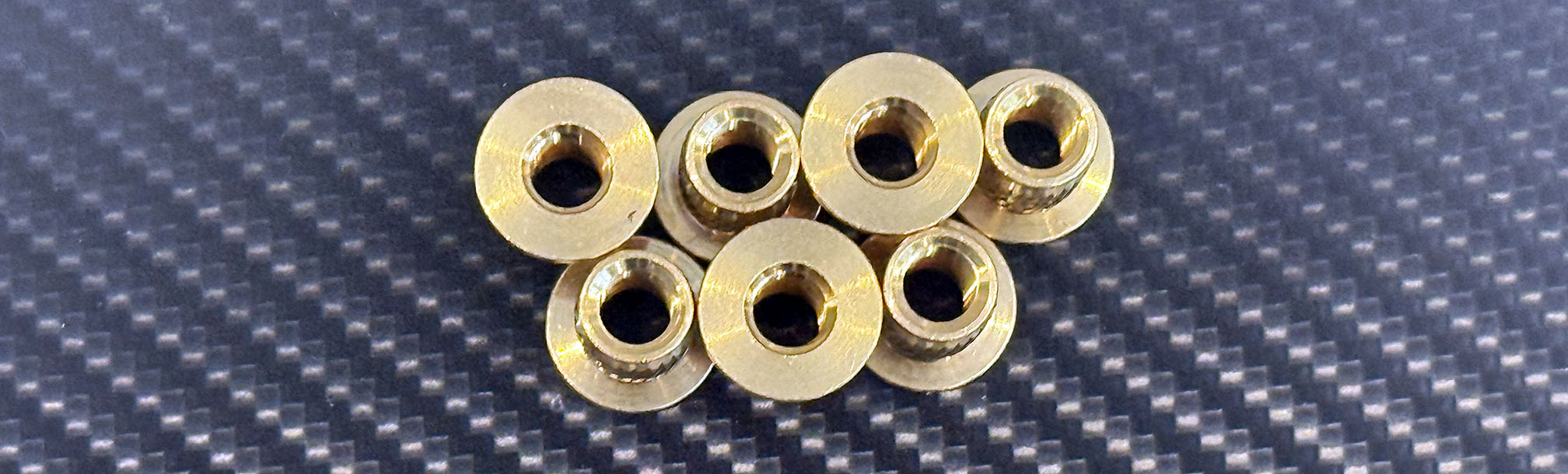
Carbon fiber reinforced polymers (CFRP) have transformed aerospace, automotive, and high-performance applications by delivering exceptional strength-to-weight ratios and fatigue resistance. But how do you create reliable threaded connections in a material that’s fundamentally different from the metals we’ve been fastening for over a century? Threaded inserts. However, their performance in carbon fiber composites brings unique challenges that don’t exist in thermoplastics or traditional materials.
Why Carbon Fiber Changes Everything
Applications of carbon fiber laminates are widely increasing in several industries due to their high specific strength, stiffness, and good fatigue resistance. However, the complexity of structures requires a high number of junctions, and in most cases, joints cannot be realized by adhesive bonding or welding to create continuous junctions. Due to the possible different nature of the parts to be connected or due to the need of disassembly and inspection of structures, discontinuous junctions are sometimes required.
This is where threaded inserts become critical. But carbon fiber isn’t just another substrate—it behaves fundamentally differently than thermoplastics:
Material Brittleness: While carbon fiber is relatively strong, it is also brittle, making the use of threaded inserts absolutely essential. Carbon fiber has a tendency to delaminate and crack under mechanical stresses like tightening bolts. This is a problem that doesn’t occur to the same degree in ductile thermoplastics.
Direct Threading Is Not Viable: Aerospace machining experts are unanimous: directly threading carbon fiber laminates will destroy the integrity of the laminate. The best way to accomplish threaded connections in composites is with molded-in inserts, or by drilling a hole after the fact and bonding in an insert.
Anisotropic Behavior: Unlike isotropic materials like metals, carbon fiber properties depend heavily on fiber orientation. Pull-out forces are significantly dependent on testing direction, even when inserts and lay-up are symmetrical to the laminate midplane. This underlines that the local complex material structure resulting from the embedding process has considerable influence on mechanical behavior.
Pull-Out Performance: The Critical Metric
Pull-out resistance is the primary performance metric for threaded inserts in composites. Thick carbon-epoxy laminates reveals both the capabilities and limitations:
Actual Performance Data
Testing of threaded inserts in carbon fiber laminates shows significant variation based on installation method and design. For M5x0.75 threads in carbon-epoxy laminates, average pull-through forces (Fultimate) were found to be 4.42 kN. Testing with larger metric screw sizes ranging from M6 to M14 showed maximum dynamic failure loads between 27.55 and 78.12 kN.
Comparative analysis shows that insert pull-out is determined using a shear strength allowable of approximately 2,000 psi for epoxy adhesive bonds. Graphs comparing inserts to aluminum substrates demonstrate that screws in Aluminum 6061-T6 or Mic6 pull out before the insert fails. This means that properly bonded inserts in composites can match or exceed the thread stripping strength of aluminum substrates.
Design Factors Affecting Pull-Out
Pull-through tests identifies several critical factors:
Laminate Thickness: Load introduction is primarily distributed over the contact area, with thicker base plates and laminates leading to significant performance enhancement, while increasing diameter has negligible impact. This means engineers should prioritize laminate thickness over insert diameter for pull-out resistance.
Insert Geometry: T-style inserts installed through the entire thickness of the laminate with a flange portion provide a mechanical lock as redundancy to the adhesive, significantly aiding pull-out load resistance. In locations where T-style inserts aren’t possible, blind inserts are used instead, though with reduced performance.
Adhesive Bond Quality: The interface between insert and composite is critical. Samples with proper surface preparation (sanding combined with controlled adhesive thickness) produced the highest shear strength. Some samples failed due to tensile failure of the composite and others failed due to inner laminar shear failure of the composite.
Installation Methods for Composites
Unlike thermoplastics where heat-staking and ultrasonic insertion are common, carbon fiber composites primarily use two installation approaches:
Co-Molded (Molded-In) Inserts
Inserts co-molded during laminate fabrication provide the best overall performance. The resin completely encapsulates the inserts during the lay-up and curing process, creating maximum mechanical interlock. This method generally results in the best bond because the composite achieves maximum flow around all external features of the insert.
That installation technique influences very little the pull-through strength when comparing different co-molding approaches. What matters most is the quality of the resin infiltration around the insert’s external features.
Bonded Inserts (Post-Cure Installation)
For post-cure installation, inserts are bonded into pre-drilled or machined holes using structural adhesives. Success depends critically on:
Surface Preparation: Both the insert and composite hole must be properly prepared. Recommendations include grit blasting or sanding the outside of inserts with 200-400 grit alumina or silica carbide, and grit blasting or sanding the composite holes before cleaning with deionized water and allowing to dry.
Adhesive Selection and Application: Using 1-2% by weight microspheres in the adhesive ensures proper bondline thickness. A 0.5-1mm gap is the recommended minimum to ensure a good bond. Machined finishes on inserts should be 63 micro inches. Inserts should incorporate 2-4 vent slots for adhesive to carry up and out the bore.
External Features: Industry standards reveal that commercial inserts like Witten inserts use either diamond knurl or annular rings on the external surface to enhance mechanical interlock with the adhesive and composite.
What Doesn’t Work: Press-In Inserts
Press-in inserts used successfully in thermoplastics are generally problematic in carbon fiber. The material’s brittleness means interference fits risk cracking, delamination, or splitting the laminate. Composite engineers should avoid press-in inserts and instead rely on bonded or co-molded solutions.
Torque-Out Performance
While pull-out resistance gets most attention, torque-out performance is equally critical for serviceability. The installation technique influences very little the pull-through strength, whilst it mostly affects the torsion strength. In particular, the failure torque is heavily influenced whether a bonding adhesive is used or not during the insert installation.
Testing of screwed joints determined by compression and torsion tests on carbon fiber laminates with M6, M8, M10, and M12 metric internal threads shows that load-carrying capability of joints increased with increasing joint size. Specimens with Helicoil reinforcement showed significantly higher maximum failure load and torque values compared to simply tapped specimens.
However, analysis proves that the effectiveness of Helicoil decreased with an increase in metric screw size. This suggests that for larger thread sizes in composites, purpose-designed bonded inserts outperform Helicoil repairs.
Insert Material Selection
By looking at the standard electrochemical potential of titanium, it seems this metal should be active. However, because of the formation of a dense stable protective oxide layer, titanium is placed among the noble materials just below graphite or carbon in the galvanic series table. Therefore, there is no significant gap between titanium and carbon-fiber-reinforced composite to create galvanic corrosion.
In general, the best option for insert material is titanium and its alloys. Commercially pure titanium and its alloys are completely resistant to galvanic corrosion when coupled with carbon composites.
Stainless steel can work but requires careful selection. Some types of stainless steels (such as types 410 or 301) are susceptible to localized pitting and crevice corrosion when connected to carbon composites in aerated 3.5% NaCl (simulated seawater). Austenitic stainless steels (300-series) and A-286 aerospace fastener alloy are guaranteed good choices.
Aluminum inserts should be avoided in carbon fiber applications exposed to moisture unless extraordinary protective measures are implemented, such as hard anodizing or protective coatings.
Galvanic Corrosion Mitigation Strategies
Several approaches can control galvanic corrosion:
Material Substitution: Replace aluminum with high-corrosion resistance titanium or austenitic stainless steel.
Electrical Isolation: Disconnect the electrical connection by placing electrically insulating material, such as fiberglass-reinforced composite, between parts. A fiberglass sleeve can be used as a shim, or a layer of fiberglass can be placed between carbon and metal interfaces during lay-up.
Protective Coatings: Use epoxy resins without hydrolysable linkages, such as ester bonds, to mitigate water penetration into the composite. Coating fasteners with aluminum organic coatings (combination of organic and inorganic resins suspended with powdered zinc and aluminum pigments) prevents direct contact between CFRP composite and fasteners.
Washers and Barriers: Use coated steel washers with aluminum organic coating at joint locations, employing top-hat geometry covering not only the fastener bearing area but also a portion of the bolt hole walls in the carbon fiber composite.
Sacrificial Anodes: For applications with unavoidable exposure to corrosive environments, incorporate sacrificial zinc components that corrode preferentially, protecting both the aluminum hardware and carbon fiber.
Damage Mechanisms and Failure Modes
Understanding how inserts fail in carbon fiber helps engineers design better solutions:
Delamination Failure
The damage mechanism changes from interlaminar delamination to push-out delamination as thread pitch increases, with outward fibering primarily observed in high pitches. Macro and scanning electron microscope (SEM) images analyzing damage mechanisms show that thread geometry significantly affects failure modes.
Hydrogen Damage
Due to hydrogen gas evolution in defect sites of the composite (such as voids and cracks), hydrogen-filled blisters can form on the composite surface when carbon fiber acts as the cathode in a galvanic couple. This represents damage to both the metal and the composite itself.
Thermal Expansion Mismatch
The coefficient of thermal expansion (CTE) of carbon fiber depends on fiber orientation, fiber loading, and resin used, creating potential issues similar to those in thermoplastics but more complex due to anisotropy. CTE mismatch between inserts and composites can cause bond failure during thermal cycling.
Engineering for Composite Reality
Threaded inserts perform exceptionally well in carbon fiber composites—when engineers respect the fundamental differences between composites and other materials. The brittleness of carbon fiber makes inserts not just beneficial but absolutely essential for any threaded connection. Direct threading destroys laminate integrity, leaving bonded or co-molded inserts as the only viable options.
The key to success lies in understanding three critical factors: proper installation technique (co-molding preferred, bonding with meticulous surface prep as alternative), appropriate insert material selection (titanium first choice, austenitic stainless second, aluminum avoided), and galvanic corrosion mitigation (electrical isolation, protective coatings, or sacrificial anodes).
Properly designed insert installations can achieve pull-out forces matching or exceeding aluminum substrates while maintaining the weight advantages of carbon fiber. The complexity of working with composites, anisotropic properties, delamination risks, galvanic corrosion, demands more sophisticated engineering than thermoplastic applications, but the performance benefits of carbon fiber justify the additional design attention.
For aerospace, automotive, and high-performance applications where carbon fiber’s strength-to-weight ratio is critical, threaded inserts aren’t just a fastening solution. Instead, they’re an enabling technology that allows engineers to realize the full potential of composite structures while maintaining the serviceability and reliability demanded by modern products.
Where does CFI fit in?
At CFI, we offer a wide range of high-performance threaded inserts and fasteners designed for composites and plastics. Contact our team at 847-918-0333 or sales@componentsforindustry.com to learn how we can support your next engineering project.
