
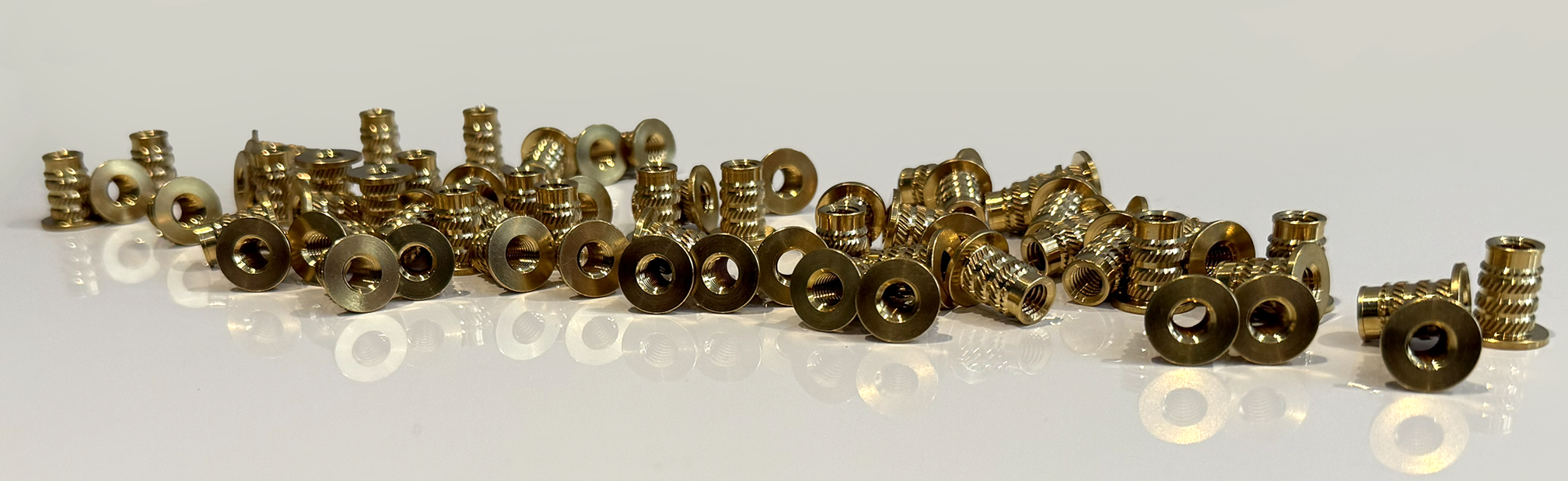
If you’re designing plastic assemblies that need to be taken apart and reassembled, you already understand that standard plastic threads simply won’t cut it. But understanding why threaded inserts are not just beneficial, but actually critical requires looking at the fundamental material science challenges that plastics present for threaded connections. Here’s what engineers need to know about why metal threaded inserts have become indispensable in modern plastic assembly design.
The Basics: Plastics Don’t Act Like Metals
This might be obvious, but the implications run deeper. Plastics exhibit material behaviors that make them fundamentally incompatible with the assumptions underlying traditional metal fastening systems. Unlike metals, plastics are susceptible to creep and stress relaxation. In addition, plastics have lower strength, higher thermal expansion coefficients, and unique viscoelastic properties that demand specialized fastening solutions compared to metals.
When standard self-tapping screws or molded-in plastic threads are used for repeated assembly applications, three critical failure modes emerge:
1. Thread Stripping During Assembly
Research on self-threading screws identifies stripping during assembly as one of the three major problem areas in plastic fastening applications. Since plastics are softer than metal, threads can be easily stripped while tightening the screw, with stress in the threads approaching the yield point of the plastic material and causing threads to shear off.
The strip-to-drive ratio (SDR), the ratio of stripping torque to driving torque, should be around 4:1 to 5:1 for high-volume manufacturing with power tools. However, achieving this ratio in plastic threads is significantly more challenging than in metal. A 2:1 ratio may be acceptable with well-trained employees using consistent components and hand tools, but this narrow margin leaves little room for process variation.
2. Material Cracking and Boss Failure
The biggest challenge when fastening into plastics is ensuring the fastener won’t crack or leave any structural or cosmetic defect, such as white marks, on the boss. Engineers need a thread design that won’t crack or damage the boss, with the material’s flexural modulus being key to determining the appropriate thread profile. Higher modulus plastics can be more brittle and more susceptible to cracking. This can be a drawback, especially when an assembly is designed for repeated assembly and disassembly.
Even when initial assembly succeeds, repeated cycling of self-tapping screws creates cumulative damage. Why? Thread-cutting screws can remove material during installation, reducing thread strength and strip margin upon reassembly. This can make them unsuitable for assemblies requiring frequent service or maintenance access.
3. Stress Relaxation and Loss of Clamp Load
This is perhaps the biggest problem. All polymers will creep or irreversibly distort when subjected to long-term stress or heat, resulting in loss of clamp load over time. Plastic is a viscoelastic material that, when under stress, tends to naturally relieve the stress. This reduces stress concentrations but also reduces the clamping load.
In assemblies using standard self-tapping screws, clamp load typically decreases progressively due to these creep effects within the plastic. Therefore, when long-term clamp load retention is critical, threaded inserts are often a more effective solution. Why? It’s because they improve load distribution and reduce localized deformation of the plastic, helping maintain more consistent clamping force over the life of the assembly.
Why Metal Threaded Inserts Solve These Problems
Metal threaded inserts provide a fundamentally different solution by creating a metal-to-metal interface between the mating fastener and the insert. This addresses all three failure modes:
Elimination of Thread Stripping
Threaded inserts provide the strength required to tighten bolts and screws to the levels needed to stretch the fastener and maintain a sufficient bolted joint assembly. The primary advantage of using an insert is that it keeps the threaded joint intact for the duration of the application, providing long-life reusable threads unlike self-tapping threads which degrade with each use.
Metal-to-metal thread engagement greatly reduces the risk of stripping during installation and repeated use.
Enhanced Pull-Out and Torque Resistance
The external features of threaded inserts—knurling, undercuts, grooves, and serrations—create mechanical interlock with the surrounding plastic that far exceeds what plastic threads can achieve. Threaded inserts have more pull-out force on a mating part than a self-tapping screw in plastics.
Key design factors affect performance:
- Insert length: The longer the insert, the greater the pull-out resistance
- Insert diameter: The greater the diameter of the insert, the more torque capacity
- Knurl pattern: Opposing knurls or diamond knurling and serrations provide pull-out resistance; straight knurls offer greatest torque resistance but less pull-out resistance; helical knurls balance resistance to forces in both directions
- Undercuts and grooves: These features increase pullout resistance by creating shear planes in the plastic
Immunity to Stress Relaxation Effects
Because the clamping load is maintained by metal-to-metal contact between the screw and insert threads, threaded inserts are essentially not affected by the plastic material stress relaxation or self-tapping screw creep. Even as the surrounding plastic undergoes stress relaxation, the metal insert maintains the threaded connection integrity. The insert provides increased seating torque for applications such as compressing O-rings and gaskets to seal a product assembly. This is critical functionality that would be lost with plastic threads experiencing stress relaxation.
Additional Critical Benefits
Beyond solving the three primary failure modes, threaded inserts provide several other critical advantages:
Improved Assembly Strength and Load Distribution
In softer metals and plastics, the shear force required to tear the fastener from the base material is much less than the tensile strength of the fastener. The threaded insert distributes forces from the fastener over a larger area to realize a much greater clamping force with the same fastener. This load distribution is particularly important in thin-wall applications or when using lower-strength plastic materials.
By embedding the insert during molding or installation, the plastic component can securely hold screws or bolts, preventing thread stripping and loosening. This makes threaded inserts a vital component in consumer electronics, automotive interiors, and household applies where reliable fastenings are essential.
Enhanced Durability in Demanding Environments
For automotive and aerospace applications, threaded inserts are important for connecting plastic components in vehicles, aircraft, and drones. These inserts provide protection against vibrations, temperature changes, and mechanical stress, ensuring a durable and secure connection even in the most demanding environments where plastic threads could quickly fail.
In automotive applications, continuous thermal cycling is a fact of life and in aerospace applications, components regularly see punishing temperature swings due to altitude stresses. In these aerospace applications, temperature swings can be plus or minus 100 degrees Celsius in a matter of minutes due to altitude changes, solar radiation, depressurization, and engine heat.
Installation Methods: Choosing the Right Approach
The criticality of threaded inserts is reinforced by the variety of installation methods available, each optimized for specific materials and performance requirements:
Mold-In Inserts
Designed for molding into plastics, rubber, and ceramics during the molding cycle, these inserts feature aggressive diamond knurling for high resistance to tensile pull and rotational torque loads. The closed bottom (blind thread) design prevents plastic flow into threads, and controlled minor diameter ensures accurate positioning on core pins. This method provides the highest performance but requires insert placement during the molding operation.
Heat-Staking (Thermal) Inserts
Perfect for thermoplastics, these inserts are installed by pressing into the mounting hole with a thermal press to melt the plastic surrounding the insert. When the plastic solidifies, it locks the insert permanently in place. This method creates a fusion bond between insert and plastic, providing excellent resistance to pull-out and torque-out loads.
Ultrasonic Inserts
Frictional heat caused by ultrasonic vibration melts the plastic surrounding the insert, allowing easy insertion. When vibration ceases, the plastic solidifies, locking the insert permanently in place. This creates a much stronger pull-out and torque-out rating compared to press-in inserts because the thermoplastic melts and reflows around the insert, establishing a secure bond between the metal insert and the thermoplastic.
Press-In Inserts
These are pressed into pre-molded or drilled holes after molding. While they typically provide weaker pull-out and torsional strength compared to other types of inserts, they offer an economical solution for lower-stress applications and can work with both thermoplastics and thermosets.
Self-Tapping Inserts
Like self-tapping screws for plastic, these inserts screw into a pilot hole. They provide the best pull-out resistance compared to other post-mold-type inserts and are particularly useful for thermoset plastics or applications where heat-staking or ultrasonic installation isn’t feasible.
Material Compatibility Considerations
Both the plastic material and the insert material matter, depending on the application. Two insertion processes, ultrasonic and heat-staking, involve remelting previously molded plastic, so they only work with thermoplastics. For thermosets, the options are molding in the insert or cold pressing the insert in later, where the elasticity of the resin material becomes critical.
The most common material for threaded inserts themselves is brass, valued for its machinability, corrosion resistance, and good performance characteristics. However, with increasing sustainability requirements, lead-free alternatives such as stainless steel or aluminum are growing more popular. Stainless steel offers better strength and corrosion resistance, while aluminum inserts are about 70% lighter than brass, which may be important for weight-sensitive applications.
Threaded inserts can be used on most of the common injection molding plastics, but proper material selection requires evaluating the shear strength of the plastic material to know whether it can handle the torque or pull-out resistance of the application.
Size Range and Application Versatility
Standard threaded inserts for plastics range from about 1/8″ to 9/16″ in diameter and 1/8″ to 5/8″ in length, with thread sizes ranging from #0-80 to 3/8-16 (M2 to M10, depending on the type). This size range accommodates a wide array of applications in industries including electronics, automotive, aerospace, defense, medical, industrial, and recreational equipment.
For physically smaller applications, such as handheld devices, micro inserts are also available as small as 1mm (0.039″) in diameter and 1.75mm (0.069″) in length, accommodating threads as small as M1.
However, it must be stated that depending on your application, Components for Industry can custom design threaded inserts for size.
Critical Component, Multitude of Uses
For plastics engineers designing assemblies that require:
- Repeated assembly and disassembly
- High torque requirements
- Reliable long-term clamping loads
- Resistance to vibration and thermal cycling
- Field serviceability
- Load-bearing threaded connections
Threaded inserts are not merely beneficial; they’re critical. The fundamental material properties of plastics make them unsuitable for high-performance threaded connections without metal reinforcement. Self-tapping screws and molded-in plastic threads have their place in permanent, low-stress assemblies, but for applications demanding reliability, durability, and serviceability, metal threaded inserts are the only viable solution.
Understanding this criticality allows plastics engineers to specify the right insert type, installation method, and design features from the beginning of the design process rather than discovering thread failure issues during production or, worse, in the field. The modest additional cost of threaded inserts is insignificant compared to the cost of warranty claims, product recalls, or compromised product performance resulting from inadequate threaded connections in plastic assemblies.
Where does CFI fit in?
At CFI, we offer a wide range of high-performance threaded inserts and fasteners designed for composites and plastics. Contact our team at 847-918-0333 or sales@componentsforindustry.com to learn how we can support your next engineering project.
