
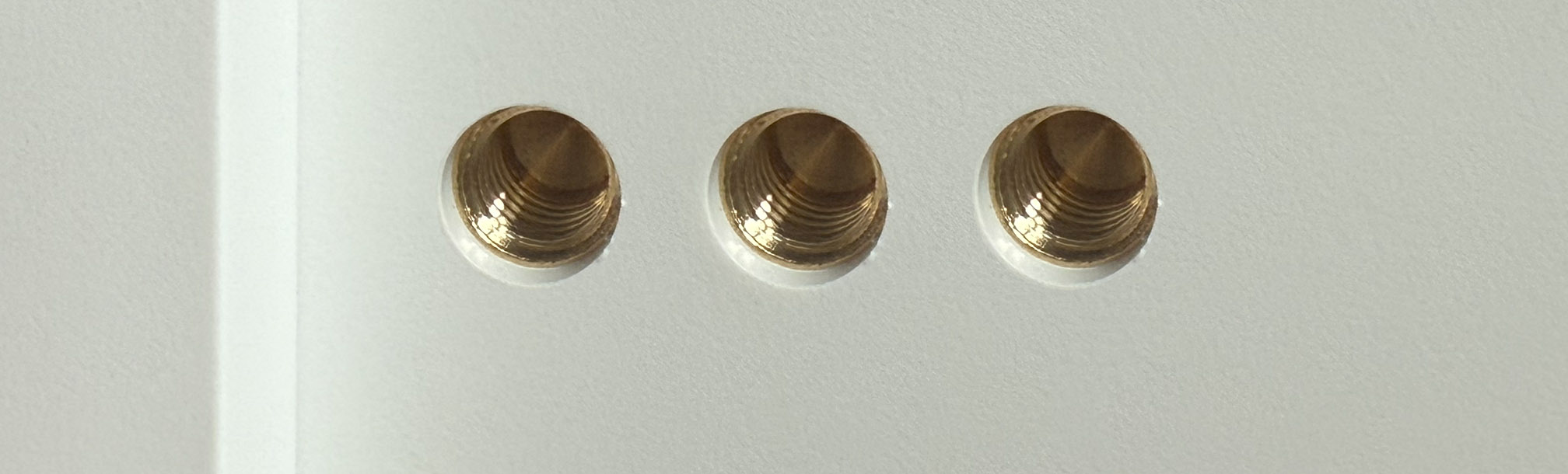
When plastics engineers think about threaded inserts, the focus often goes straight to the insert itself, looking at attributes such as knurl pattern, installation method and material selection. But here’s what gets overlooked: the insert is only as good as the load path supporting it. A perfectly specified insert installed in a poorly designed boss could fail just as quickly as a cheap insert in a well-designed structure. Understanding how load paths affect threaded insert performance is critical for creating reliable plastic assemblies that survive real-world loading conditions.
What Is a Load Path and Why Does It Matter?
A load path is the route through which forces travel from the point of application through the structure to the ground or support. In threaded insert applications, loads applied to the fastener must transfer through the insert, into the surrounding plastic boss, through any supporting structures (ribs, gussets, walls), and ultimately into the main body of the part.
When a fastener is installed into a substrate, it introduces a combination of axial (clamping), radial (expansion), and torsional (driving) forces concentrated into a small region at the threads and under the head of the fastener. Metals can redistribute these forces effectively due to their stiffness and ductility. Plastics, however, respond differently when subjected to mechanical loads, exhibiting behaviors such as creep, stress relaxation, and, in reinforced materials, anisotropy, with strength varying by polymer type and fiber orientation.
The effectiveness of the load path determines whether these forces distribute evenly through the plastic structure or concentrate at stress points, leading to premature failure.
Primary Loading Modes for Threaded Inserts
Threaded inserts in plastic assemblies experience three primary loading modes, each creating distinct demands on the load path:
1. Pull-Out (Tensile) Loading
This is the most critical load case for threaded inserts. Pull-out resistance depends fundamentally on the shear surface area between the insert and plastic. Because threaded inserts have a larger outer diameter than screws, they significantly increase the shear surface available to carry load, improving joint strength compared to plastic threads alone.
Pull-out loads transfer from the internal threads through the insert body to the knurled external surface, then into the surrounding plastic as shear stress. Increasing insert engagement length and boss wall thickness has the greatest impact on pull-out performance, while increases in insert diameter provide incremental but meaningful gains.
2. Torque-Out (Rotational) Loading
When a mating fastener is tightened or loosened, rotational forces attempt to spin the insert within the plastic boss. The key strength factor is resistance to the insert twisting in the part when the mating fastener is torqued. The longer the insert, the greater the pull-out resistance; the greater the diameter of the insert, the more torque capacity.
The load path for torque-out follows the external knurl pattern. Straight knurls parallel to the insert length offer the greatest resistance to torque but less to pull-out, while helical or diagonal knurls balance resistance to forces in both directions. The diamond knurl pattern is probably most common, offering resistance in all directions.
3. Combined Loading
Real-world applications rarely involve pure pull-out or pure torque-out. Assembly operations create combined loading where installation torque, clamping forces, and service loads all act simultaneously. The metal threads of an insert eliminate thread creep and significantly reduce load loss, even as the surrounding plastic may still experience stress relaxation.
Critical Load Path Elements
Boss Geometry: The Foundation
The boss is where the load path begins, and its geometry directly determines insert performance. According to injection molding design principles, wall thickness for bosses should be around 40-60% of the nominal wall thickness1, balancing the need for fastener holding strength with the risk of sink marks, while ensuring sufficient material for thread engagement.
Wall Thickness: Boss wall thickness should be less than 60% of nominal wall to minimize sink marks and voids. However, if the boss is not in a visible area, wall thickness can be increased to allow for increased stresses imposed by inserts. Wall thickness greater than 60% can create voids and sink marks and may also expand cycle time.
Outer Diameter: The outside diameter of a boss should be 2 to 2.5 times the hole diameter to ensure adequate strength. This provides sufficient plastic volume around the insert to resist hoop stresses during installation and service loading.
Height-to-Diameter Ratio: Boss height should generally not exceed 3 times the nominal wall thickness (h ≤ 3T)2. Taller bosses with thick bases can cause cooling problems, lead to sink marks, and increase cycle time. Additionally, tall thin core pins used to form the internal hole are difficult to cool and can bend during the molding process.
Ribs and Gussets: Load Distribution
A standalone boss is a weak boss. The load path must connect to nearby walls through ribs or gussets to distribute forces and prevent localized failure. Bosses should be connected to the nearest sidewall for better rigidity and material flow, providing additional load distribution for the part.
Rib Design Principles:
- Rib thickness should be 40-60% of nominal wall thickness
- For amorphous materials (polycarbonate, ABS, PC/ABS), maximum rib width is 70% of nominal wall3
- For semi-crystalline materials (polypropylene, nylons, polyesters), maximum rib width is 60% of nominal wall
- Ideal draft for ribs is 0.5° to 1° per side
Gusset Placement: Gussets at the base of bosses significantly enhance strength and resistance to applied loads. For tall or isolated bosses, gussets become essential for preventing deformation or breakage during molding or use.
Fillets and Radii: Stress Management
Sharp corners create stress concentrations that disrupt smooth load paths. The intersection of the base of the boss with the nominal wall is typically stressed, and stress concentration increases if no radii are provided.
Design Guidelines:
- Fillet radius at boss base should be 0.25 to 0.5 times the nominal wall thickness
- Base radius minimum should be 0.25 × thickness4
- Fillets help distribute stress evenly and improve material flow patterns
- Sharp transitions between boss and base can create stress points leading to cracking
Boss-to-Wall Connections
Attaching the boss to the sidewall ensures even material flow and additional load distribution. For improved rigidity and material flow, a boss should be connected to the nearest sidewall. This connection creates a continuous load path that prevents the boss from acting as an isolated feature subjected to concentrated stresses.
How Load Path Failures Manifest
Understanding failure modes helps identify load path deficiencies:
Hoop Stress Cracking
When an insert is pressed or installed, it creates radial expansion that induces hoop stress in the surrounding plastic. Hoop stresses are imposed on the boss walls by press fitting or otherwise inserting inserts. If the boss wall is too thin or the material too brittle, plastic may crack when it shrinks too much around the insert due to an increase in hoop stress.
The maximum hoop stress occurs at the inner diameter of the boss. Inadequate boss wall thickness or improper material selection creates a weak load path that cannot accommodate these stresses.
Pull-Out from Inadequate Engagement
Pull-out failures occur when the load path through the insert-plastic interface fails in shear. Self-tapping inserts have a thin thread profile to minimize inducing stress into the plastic and a relatively coarse pitch to provide the maximum plastic shear surface to resist pull-out. The longer the insert, the better the pull-out value. In other words, length directly correlates with available shear surface area.
Short inserts in shallow bosses create insufficient load path length, concentrating shear stress over too small an area.
Boss Breakage at Base
When ribs or gussets are absent, the entire fastening load concentrates at the boss-to-wall junction. Without proper fillets, this sharp transition becomes a stress concentrator. The load path has nowhere to distribute forces, resulting in fracture at the base.
Insert Rotation from Torque
Insufficient boss diameter or straight knurls without supplemental grooves create a weak rotational load path. When assembly torque exceeds what the insert-plastic interface can resist, the insert spins, destroying the knurl engagement and compromising joint integrity.
Optimizing Load Paths for Insert Performance
Material Flow During Molding
The load path begins during initial manufacturing of the assembly. For molded-in inserts, the resin completely encapsulates the inserts, with plastic filling the knurls, barbs, and undercuts, providing torque and pull-out resistance. This method generally results in the best overall bond because plastic achieves maximum flow into all external features of the insert.
For post-mold installation methods like heat-staking or ultrasonic insertion, frictional heat melts the plastic surrounding the insert. When vibration or heat ceases, the plastic solidifies, locking the insert permanently. This creates a much stronger pull-out and torque-out rating compared to press-in inserts because the thermoplastic melts and reflows around the insert, establishing a secure bond.
Strategic Boss Placement
Position bosses in thicker wall regions or primary load paths to ensure mechanical support. Avoid placing them in thin walls, sharp corners, or zones prone to stress concentration. Tie bosses into the surrounding structure with ribs or gussets for load distribution and moldability benefits.
Recommended boss locations include:
- Thick-walled areas that provide firm fastening and stability
- Primary stress paths of the part to enhance overall strength
- Interior placement to protect from external damage
- Away from gate areas to prevent weld lines that reduce strength
Mating Part Considerations
The load path simply doesn’t end at the insert itself. Instead, it continues through the mating component such as the screw or bolt that works with the insert. The diameter of the clearance hole in the mating component is very important. The insert – and not the plastic – must carry the load. The hole in the mating component must be larger than the outside diameter of the assembly screw but smaller than the pilot or face diameter of the insert to prevent jack-out.
If a larger hole in the mating component is required for alignment purposes, a headed insert should be considered to distribute bearing loads properly.
Compression Limiters for Through-Loading
When compressive loads pass through the plastic (such as when clamping two plastic parts together), standard threaded inserts are insufficient. Compression limiters are non-threaded inserts commonly used in applications where compressive load is applied to plastic assemblies. The compression limiter strengthens the plastic and withstands the compressive force applied when a mating screw is tightened, ensuring the integrity of the plastic is not compromised by the applied load.
Testing Load Path Effectiveness
Proper testing validates load path design:
Pull-Out Testing: Measures the force required to extract the insert from the boss, directly assessing the shear strength of the insert-plastic interface and the effectiveness of the boss geometry.
Torque-Out Testing: Measures rotational resistance by attempting to spin the insert while torquing a mating fastener, evaluating the knurl pattern effectiveness and boss diameter adequacy.
Combined Loading: Realistic testing applies installation torque followed by pull-out loading to simulate actual service conditions where the assembly has been torqued and then subjected to tensile forces.
Load Paths: The Foundation of Insert Performance
Threaded insert performance is fundamentally a load path problem. The insert provides the metal-to-metal interface for the fastener, but the surrounding plastic structure must effectively distribute forces from that interface throughout the part. A weak load path -whether from inadequate boss geometry, missing ribs, sharp corners, or improper material selection – will cause insert failure regardless of insert quality.
Plastics engineers who understand load paths design bosses with appropriate wall thickness (40-60% of nominal), connect bosses to sidewalls with ribs (also 40-60% of nominal thickness), incorporate generous fillets (0.25-0.5× wall thickness), limit boss height (≤ 3× wall thickness), and position bosses in primary load-bearing regions of the part. These practices create continuous, well-distributed load paths that allow threaded inserts to achieve their full performance potential.
The insert is the fastening interface, but the load path is what makes that interface work. Ignore the load path, and even the best insert will fail prematurely. Design the load path properly, and standard inserts will deliver exceptional performance throughout the product’s service life.
Where does CFI fit in?
At CFI, we offer a wide range of high-performance threaded inserts and fasteners designed for composites and plastics. Contact our team at 847-918-0333 or sales@componentsforindustry.com to learn how we can support your next engineering project.
Sources
- Plastic Moulds. “Designing Bosses For Injection Molding: A Complete Guide.” Obtained from: https://www.plasticmoulds.net/designing-bosses-for-injection-molding-a-complete-guide.html ↩︎
- EYCPU. “How to Design Screw Boss on Plastic Molded Parts.” https://www.eycpu.com/blog/how-to-design-screw-boss-on-plastic-molded-parts/ ↩︎
- PTA Plastics. “Boss and Rib Design.” Obtained from: https://www.ptaplastics.com/blog_post_boss_ribs.html ↩︎
- HCL DFMPro. “Design Guidelings for Bosses.” Obtained from: https://dfmpro.com/manufacturing-processes/dfmpro-for-injection-molding/2/ ↩︎
