
If you’re a plastics engineer working on automotive applications, thermal cycling is undoubtedly a four-letter word in your world. After all, it’s one of the most punishing environments your components will face. In addition, it places stress1 on not only your plastic and composite parts, but also places strain on our threaded inserts that are specifically engineered to help bolster them.
Here’s what might surprise you: the threaded inserts you’re specifying for those assemblies are experiencing a completely different set of stresses than the plastics surrounding them. Understanding this mismatch, and in turn, designing for it, can mean the difference between a reliable assembly and a field failure.
What Does Thermal Cycling Actually Do to Automotive Plastics?
Thermal cycling isn’t just about getting hot or cold. Instead, it’s about the repeated expansion and contraction that occurs when temperature changes under geometric constraints. According to materials science research, thermal stresses are produced by cyclic material expansion and contraction when temperature changes, and a crack may develop after many cycles of heating and cooling.
In automotive applications, thermal cycling is particularly severe. Engine compartments experience temperature fluctuations as a result of day-night cycles and climatic variation, with the globally accepted specification for underhood temperatures being 125°C (257°F). Industry experts note that underhood air temperatures can reach 100°F above ambient as a rule of thumb, with worst-case scenarios pushing brake components to 250°F continuous and sometimes as high as 300°F intermittent.
But heat is not the main issue at work – it’s rate of change. In thermal cycling, plastics, metals and composites expand when heated and contract when cooled. This can cause uneven deformation and thermal stress, impacting structural integrity and long-term performance. The wider the lowest to highest temperature point, the more intense the thermal stress imposed on a car’s materials. This is frankly unavoidable in ICE-powered cars, but it’s how you deal with it as material scientists and engineers that matters.
Why does the Coefficient of Thermal Expansion matter?
Here’s where things get interesting for threaded inserts. Plastics and metals have drastically different coefficients of thermal expansion (CTE). The CTE of plastics is much higher than that of metals. This means that plastics tend to expand and contract more with temperature changes.
To put this fully into perspective, engineering plastics like nylon expand and contract at approximately 10x the rate of steel! For a 100mm diameter unfilled PA6/66 nylon component, thermal expansion would be 0.12mm per 10°C of temperature increase or decrease2. For a 1000mm length, that same nylon component could increase by 1.2mm per 10°C.
Standard unfilled thermoplastics have CTEs ranging from 0.6 × 10⁻⁴ to 2.3 × 10⁻⁴ K⁻¹3, while metals like brass, steel, and aluminum used in threaded inserts typically range from 0.1 × 10⁻⁴ to 0.3 × 10⁻⁴ K⁻¹. This 5x to 10x difference creates significant interfacial stress between the insert and the surrounding plastic, particularly during thermal cycling.
What Happens at the Insert-Plastic Interface?
When temperature cycles occur, the plastic surrounding a threaded insert wants to move much more than the metal insert itself. Without careful design and planning, this differential expansion creates several potential failure mechanisms:
1. Hoop Stress and Cracking
During heating cycles, the plastic expands outward while the metal insert resists this expansion. During cooling, the plastic contracts more than the insert, creating compressive forces. Plastic might crack when it shrinks too much around inserts due to an increase in hoop stress. This is particularly problematic in hard or brittle plastics where the material has limited ability to accommodate these dimensional changes.
2. Interface Debonding
The CTE mismatch causes an internal stress field with a maximum around the interface between the insert and plastic. Under thermal cycling, alternating plastic strains give rise to low-cycle fatigue characterized by interface cavitation and debonding. Studies of fiber-reinforced composites show that after 1000 thermal cycles between ambient temperature and 320°C, voids and interface debonds are generated, resulting in macroscopic damage with reduction in mechanical properties and dimensional changes.
3. Pull-Out Force Degradation
For threaded inserts, the most critical performance metric is pull-out resistance. Thermal cycling directly attacks this. The knurling pattern that provides mechanical interlock with the plastic relies on the plastic maintaining intimate contact with the insert’s external features. As thermal cycling induces microcracking of the resin matrix and degradation of mechanical properties, the plastic’s ability to resist pull-out forces diminishes.
Research on automotive adhesive joints shows that thermal cycling leads to residual stresses in polymeric layers generated over time as a result of viscoelastic response, which leads to damage and debonding, thus reducing bond durability.
4. Creep Acceleration
Elevated temperatures don’t just cause expansion, they can accelerate creep. Long-term thermal cycling at temperatures approaching the glass transition temperature (Tg) can cause permanent set or deformation. Residual stress state or amount of permanent set as a result of thermal cycling while restrained can be estimated using thermal expansion coefficient, modulus versus temperature data, and stress relaxation data.
Design Strategies for Fastener Engineers
Understanding these failure mechanisms allows for better design decisions. Here’s what works:
Plastic Material Selection
High-Temperature Plastics: For underhood applications, materials like polyphenylene sulfide (PPS) with CTEs comparable to aluminum, excellent dimensional stability, and extremely low creep perform well to 240°C (464°F). Polyamides modified for heat resistance and hydrolytic stability are also proven options.
Insert Design Optimization
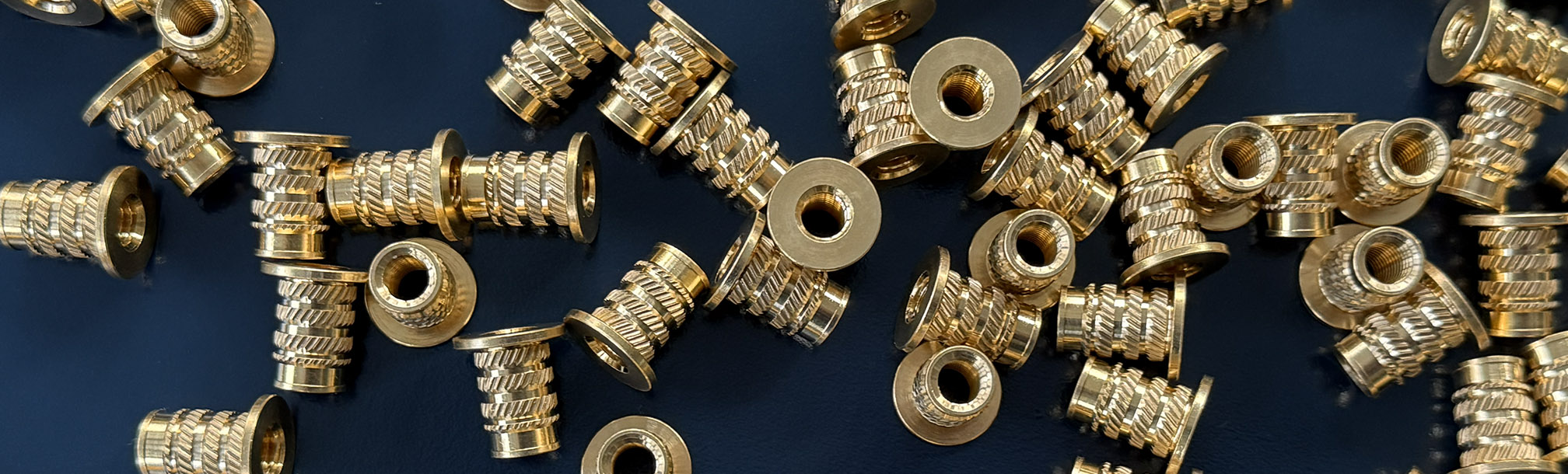
Knurl Pattern Selection: The knurling pattern directly impacts how the insert responds to thermal cycling. Helical or diamond knurls balance resistance to both pull-out and torque forces while allowing some accommodation of differential expansion. Straight knurls offer maximum torque resistance but provide less pull-out resistance and create higher localized stresses during thermal cycling.
Undercuts and Grooves: Opposing knurls, undercuts, and grooves on the external surface provide torsional and pull-out resistance. Grooves between knurl bands allow plastic to flow and mechanically lock, creating shear planes that resist pull-out even as the interface experiences thermal stress.
Insert Length: Longer inserts distribute thermal stresses over a greater surface area. The longer the insert, the greater the pull-out resistance, which provides margin for degradation during thermal cycling.
Finding the perfect match between metal and polymer
Thermal cycling in automotive plastics creates a hostile environment for threaded inserts due to CTE mismatch between metals and polymers. The repeated differential expansion and contraction attacks the insert-plastic interface through hoop stress, debonding, creep, and mechanical property degradation.
Success requires a systems approach: selecting appropriate plastic grades, optimizing insert design (knurl pattern, length, undercuts), and designing robust boss geometry.
Plastics and fastener engineers can work together to understand these interactions and design assemblies that maintain reliable threaded connections over the vehicle’s full service life – even in the harsh under-hood thermal conditions.
Where does CFI fit in?
At CFI, we offer a wide range of high-performance threaded inserts and fasteners designed for composites and plastics. Contact our team at 847-918-0333 or sales@componentsforindustry.com to learn how we can support your next engineering project.
